The Iron Balcony That Let Landlords Off the Hook: A Fire Escape's Complicated Legacy
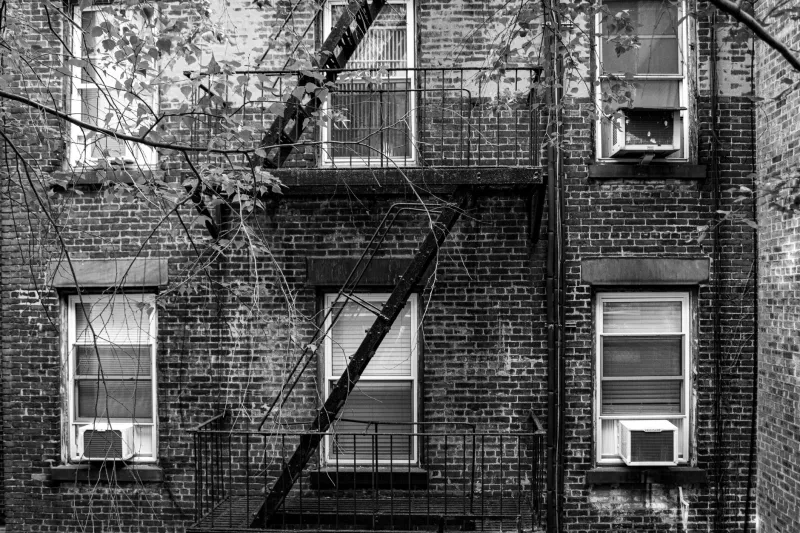
Walk down any street in New York, Boston, or Philadelphia and you'll see them: those black iron skeletons clinging to the sides of old brick buildings. They've starred in a thousand movies, hosted a million cigarette breaks, and served as the backdrop for at least one iconic Bob Dylan album cover. But the fire escape has a more complicated origin story than its romantic reputation suggests — one that involves genuine heroism, cynical landlords, and city governments looking for the cheapest way out of a deadly problem.
A City That Kept Burning
In the mid-1800s, American cities were growing faster than anyone could regulate. Immigrant families packed into tenements — five, six, seven stories tall, with narrow stairwells and wooden interiors that turned every kitchen fire into a potential mass casualty event. New York's tenement districts were, by the accounts of the era, death traps. When fire broke out on an upper floor, residents had exactly one route out: a single interior staircase that often acted like a chimney.
The solution seemed obvious. If people couldn't get down through the building, they needed a way out of it. Enter the external fire escape — iron balconies and staircases bolted to the outside wall, floor by floor, giving tenants a second route to the ground.
Early versions were crude. Some were just ladders. Others were baskets on ropes. But the concept caught on, and by 1860s New York, reformers were pushing to make fire escapes mandatory on all multi-story residential buildings.
The Loophole Nobody Talks About
Here's where the story takes a turn. When cities finally did pass laws requiring fire safety measures in tenements, the fire escape became the minimum standard — and, in practice, the only standard. Landlords discovered that bolting a few hundred dollars' worth of iron railings to a building's exterior was vastly cheaper than widening stairwells, installing fire-resistant materials, or adding second interior exits.
The fire escape, in other words, became a substitute for real reform rather than a complement to it. Buildings that were structurally dangerous — cramped, flammable, poorly ventilated — got a pass as long as the iron ladder was there. And even then, compliance was often a joke. Fire escapes rusted. Windows leading to them were nailed shut or blocked by stored furniture. Some landlords installed them only after inspections, then let them decay.
The infamous Triangle Shirtwaist Factory fire of 1911 made the flaw brutally clear. The building had a fire escape — a flimsy one, badly designed, that collapsed under the weight of fleeing workers. One hundred forty-six people died. The fire escape wasn't the villain of that tragedy, but it certainly wasn't the hero, either.
From Life-Saver to Set Dressing
As building codes matured through the 20th century, the fire escape's role shifted. New codes began requiring enclosed, fire-protected interior stairwells, sprinkler systems, and pressurized stairwells in high-rises. The external fire escape stopped being the cutting edge of safety and started being a relic.
New construction largely abandoned them. You won't find fire escapes on buildings built after World War II in most American cities — modern codes favor protected interior stairs and, increasingly, sprinklers. What remains is a kind of architectural ghost: the fire escapes of Boston's North End or Manhattan's Lower East Side are survivors from an earlier regulatory era, maintained (sometimes) for their charm as much as their function.
Culture did the rest. Hollywood fell in love with the fire escape as a stage. It's where Audrey Hepburn's Holly Golightly sang "Moon River." It's the setting for countless meet-cutes, sneaky exits, and contemplative scenes of city loneliness. The device meant to evacuate the poor became a romantic shorthand for urban life itself.
Why the Story Still Matters
The fire escape's history is a lesson in how safety regulation can be gamed. A device designed to protect people became a way for the powerful to avoid deeper obligations — and cities let it happen because it was cheap and looked like action.
So next time you pass one of those iron ladders, give it a second look. It's not just a fire drill rendezvous point or a photographer's favorite. It's evidence of a very American compromise: a real solution to a deadly problem, watered down into the cheapest possible version of itself — and then, somehow, turned into a movie star anyway.