The Bill That Survives the Washing Machine: How a Counterfeiting Crisis Invented America's Toughest Paper
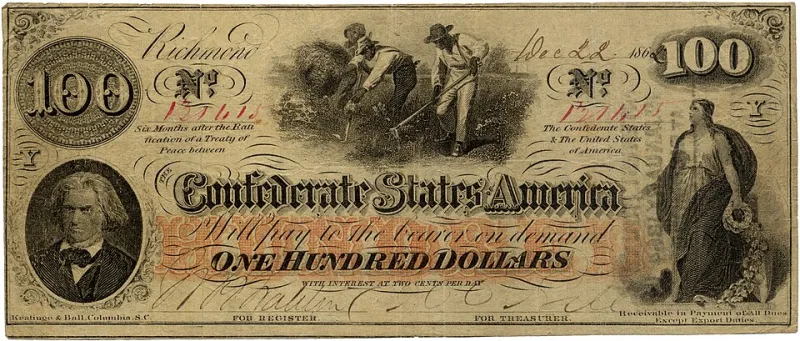
Photo: Confederate States of America., Public domain, via Wikimedia Commons
Go ahead and pull a dollar bill out of your wallet and bend it. Then fold it, crumple it, and — if you've ever accidentally left cash in your jeans — imagine running it through the washing machine. Most paper would be pulp. The twenty in your pocket shrugs it off.
That's because the thing we call "paper money" isn't paper. It's a textile — roughly 75 percent cotton and 25 percent linen, a blend produced by a single secretive supplier and engineered to a specification the average person never thinks about. The story of how American money got that recipe doesn't start with a desire for durability. It starts with a national crisis, a wave of criminals, and a government desperate to make its money un-copyable.
Chaos Money: America Before the Greenback
For most of its first century, the United States didn't have national paper currency at all. Banks printed their own notes, merchants issued scrip, and somewhere north of 8,000 different varieties of paper money circulated by the 1850s — each one an invitation to fraud.
Counterfeiting was rampant and, in many places, barely prosecuted. Some criminals ran entire fake banks, printing worthless notes for banks that didn't exist. Detectives and merchants relied on thick reference books called "counterfeit detectors" to sort genuine bills from fakes, and even then, everyday Americans got swindled constantly.
Then came the Civil War, and with it, financial chaos. The Union government, desperate to finance the war without draining its gold reserves, passed the Legal Tender Act in 1862 and began issuing federal paper money for the first time — the famous "greenbacks," named for the distinctive ink on their backs.
The moment Washington put its own paper in every pocket, it also put a giant target on itself. Counterfeiters pivoted from fake bank notes to fake federal ones, and the young national currency's credibility hung on a single question: could the government make a bill that couldn't be convincingly copied?
The Recipe Nobody Wanted to Share
The answer came in layers, and the first layer was the material itself.
Ordinary paper, made from wood pulp, was easy to buy, easy to print on, and easy to imitate. The government instead turned to a rag-based stock — cotton and linen fibers — that required specialized equipment, controlled ingredients, and production know-how that counterfeiters couldn't simply walk into a stationery store and find. The blend also had a telltale feel: crisp, slightly fabric-like, with a snap that wood-pulp paper couldn't replicate. Bank tellers were trained to know it by touch.
The security layered on from there. In the 1860s the government began engraving currency with impossibly intricate designs — the dense scrollwork and fine-line portraits that remain on bills today — produced by master engravers whose work was effectively impossible to reproduce with the photography of the era. Later came the Bureau of Engraving and Printing, which centralized production and took the recipe in-house.
And in one of the great ironies of American history, the federal agency eventually charged with hunting down counterfeiters was the Secret Service — created in 1865, its original mission not protecting presidents but protecting the currency. At the time, by some estimates, a huge share of the currency in circulation was fake. The money had to be saved before the Secret Service ever got around to guarding a president.
A Material Built to Be Abused
The counterfeiting crisis faded, but the fabric blend stayed — and it turned out to solve a problem nobody had set out to solve: durability.
A wood-pulp bill wouldn't survive the life of a working twenty. A US note endures an astonishing gauntlet — folded thousands of times, sweated on, laundered, buried in wallets, run through vending machines. The cotton-linen blend absorbs ink deeply, resists tearing when wet, and holds up through years of circulation. Small bills typically last several years; the $100, handled less often, can survive more than two decades.
The blend also became the foundation for every modern security feature. Security threads woven into the paper since the late 1980s, watermarks visible when held to light, color-shifting ink — all of it depends on that specialized substrate. You can't laminate a thread inside ordinary paper the way you can inside a fabric-based sheet.
Today the material comes from a single source, and its exact formulation is treated as a genuine secret. The government doesn't just guard the designs on the money; it guards the money's body.
The Everyday Miracle in Your Wallet
There's something fitting about the whole story. The most widely handled manufactured object in American life — touched by nearly every adult, every day — is a material born from desperation, refined by a war economy, and kept alive by a counterfeiting arms race that never really ended.
So the next time you pull a crumpled bill from your pocket, still crisp after a trip through the wash, give it a little respect. It's not paper. It's a survivor — a Civil War-era security measure that quietly became one of the toughest fabrics you'll ever own, and the only one you'll ever spend.